Web Scraping for Food & Restaurant Data
Extract restaurant listings, structured menus, food item pricing, operating hours, customer reviews, and geolocation data from major food directories, maps, and review platforms at enterprise scale.
- Scrape full restaurant menus with prices, categories & ingredients
- Extract operating hours, contact details & geolocation coordinates
- Aggregate customer ratings, review counts & sentiment data
- Monitor competitor menu changes and food pricing trends
- Collect cuisine types, dietary tags & allergen information
- Bypass anti-bot systems on major food directories & maps
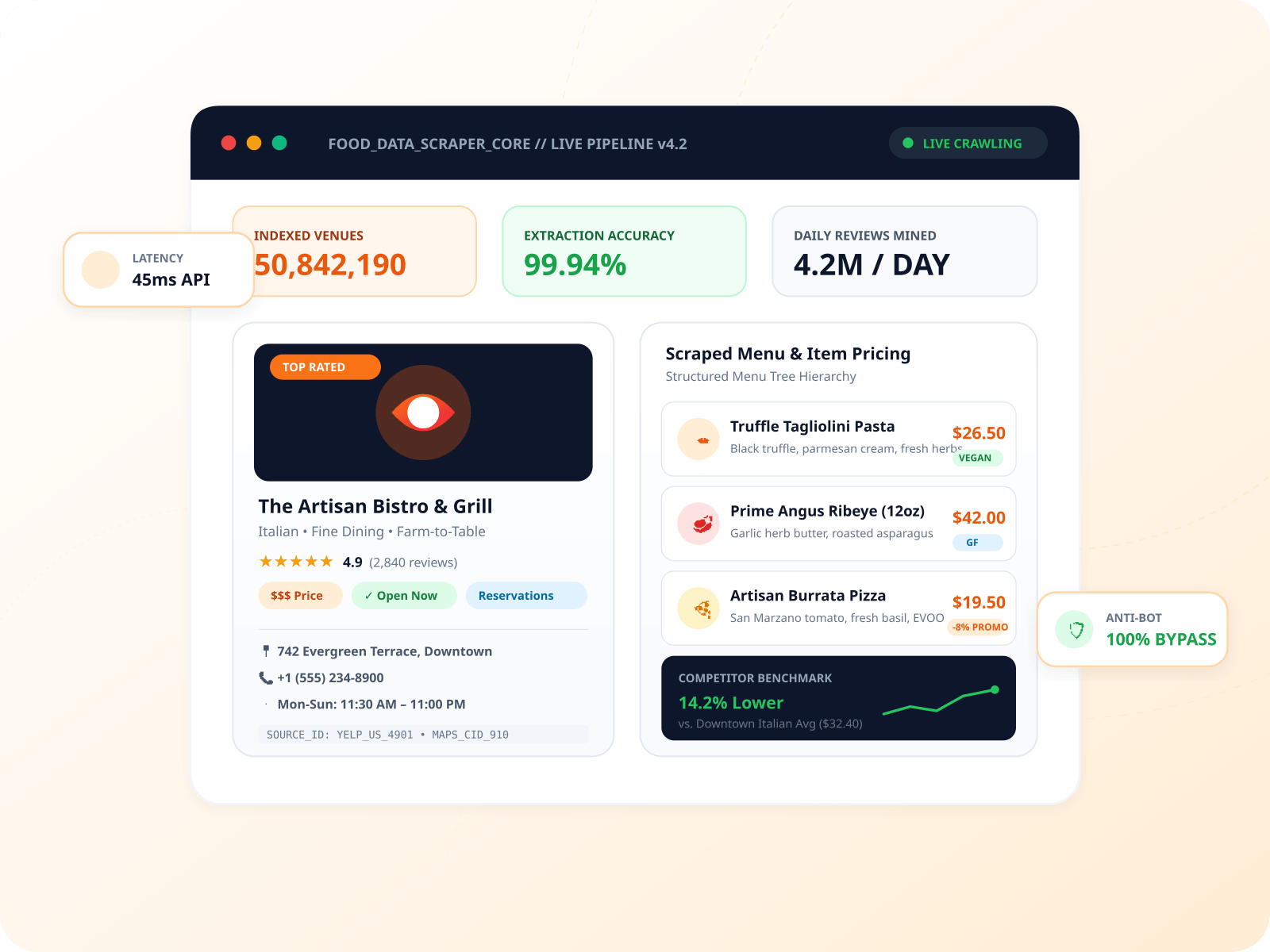
What is Food & Restaurant Data Scraping?
Food and restaurant data scraping is the automated extraction of structured information from restaurant directories, food review portals, map-based discovery platforms, and food delivery aggregators. Restaurant chains, food-tech startups, hospitality analytics firms, and market research companies rely on scraped food data to build competitive intelligence tools, power menu recommendation engines, track competitor pricing, analyze dining trends, and enrich location-based food discovery applications.
- ✓Extract complete restaurant profiles including name, cuisine, category, and brand ownership.
- ✓Scrape structured menu hierarchies including categories, items, descriptions, and prices.
- ✓Collect operating hours, reservation links, delivery options, and contact details.
- ✓Aggregate star ratings, review counts, and consumer sentiment across platforms.
- ✓Capture geolocation data, neighborhood tags, and map-linked address coordinates.
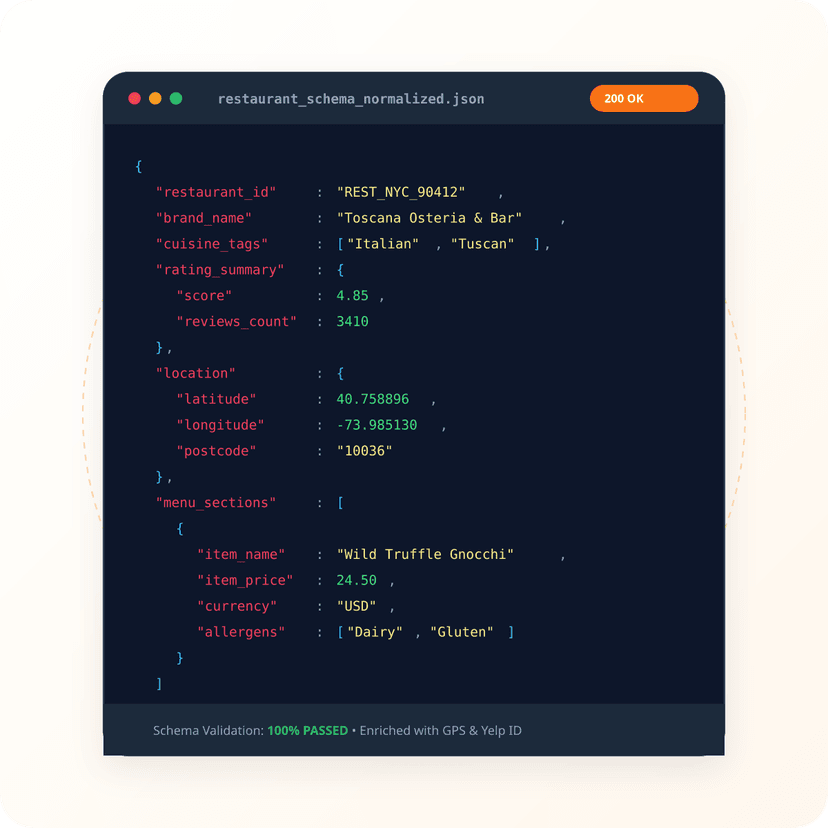
Structured Food & Restaurant Data Fields
We normalize restaurant and menu data from directories, maps, and review portals into a unified schema ready for analytics, recommendation engines, and market intelligence platforms.
Enterprise Features for Food Data Scraping
Restaurant Directory & Profile Scraping
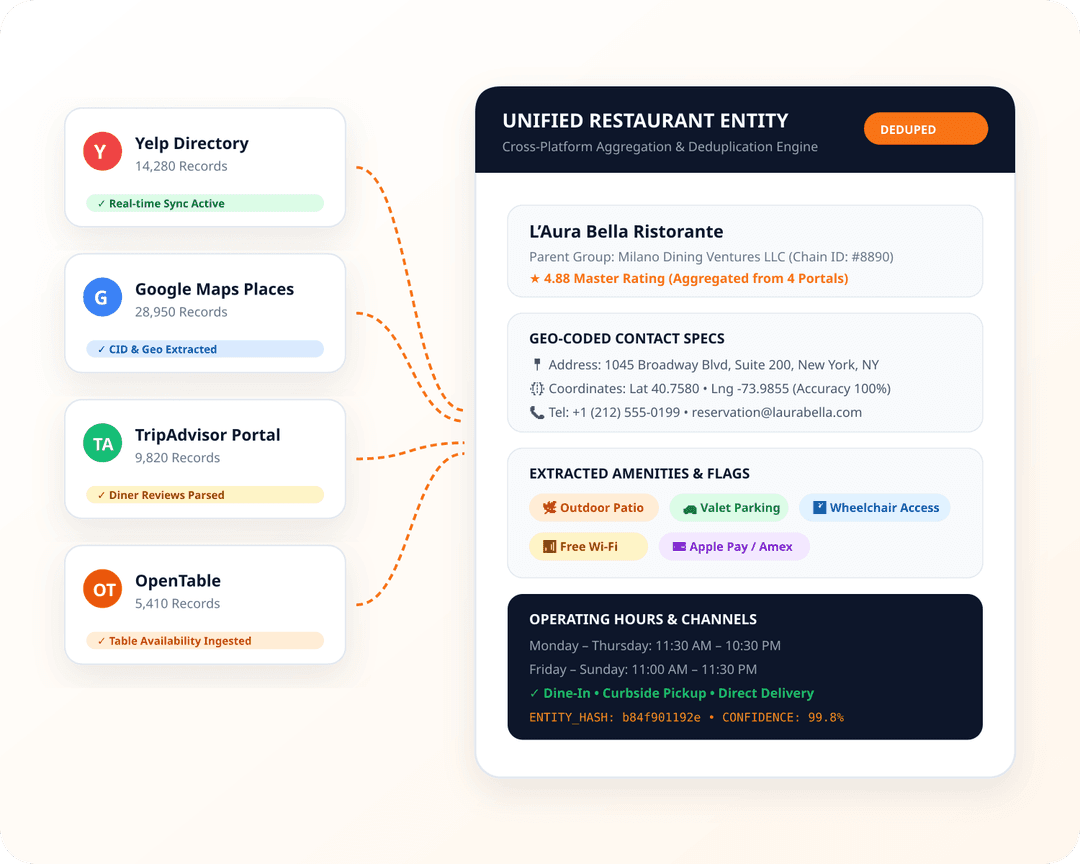
Build exhaustive restaurant databases by scraping complete business profiles across Yelp, Google Maps, TripAdvisor, Zomato, and OpenTable — including contact details, cuisine classifications, chain ownership, amenities, and geo-coordinates at city and country scale.
- ✓Multi-Directory Aggregation: Consolidate restaurant profiles from Yelp, Google Maps, TripAdvisor, and Zomato into a single, deduplicated database.
- ✓Chain & Franchise Mapping: Identify chain restaurants, map franchise locations, and link individual outlets to parent brand entities.
- ✓Amenity & Feature Extraction: Capture outdoor seating, parking availability, Wi-Fi, accessibility features, and accepted payment methods.
Menu Data & Item Pricing Extraction
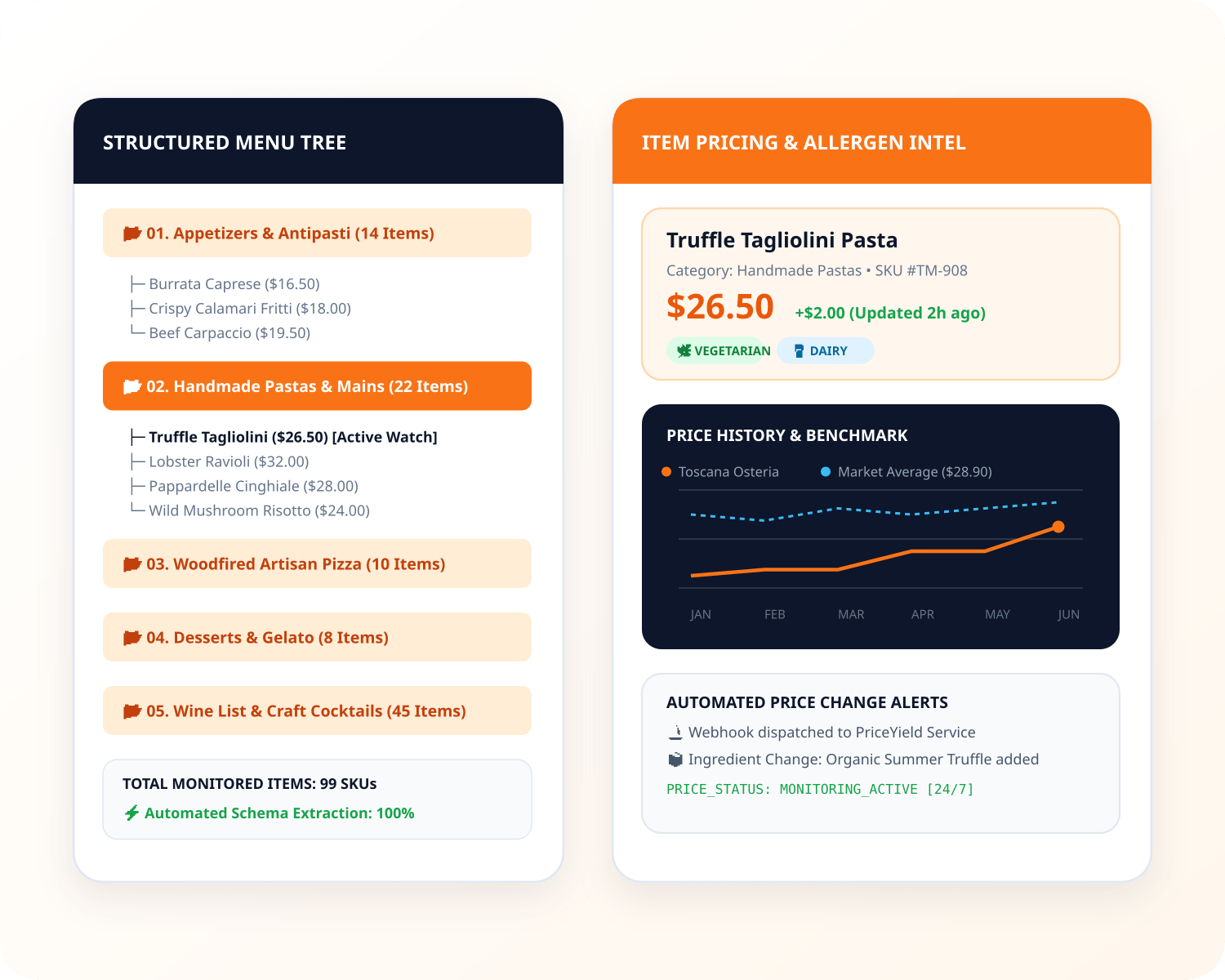
Scrape complete menu hierarchies — categories, subcategories, items, descriptions, prices, portion sizes, and dietary flags — directly from restaurant websites, food delivery apps, and listing portals to power menu intelligence and competitive benchmarking.
- ✓Structured Menu Hierarchy: Extract full menu trees including appetizers, mains, desserts, beverages, and combo meals with item-level pricing.
- ✓Dietary & Allergen Tags: Capture vegetarian, vegan, gluten-free, halal, and allergen classifications for each menu item.
- ✓Price Change Detection: Monitor competitor menu pricing movements and trigger alerts when item prices are updated or new items are added.
Ratings, Reviews & Sentiment Mining
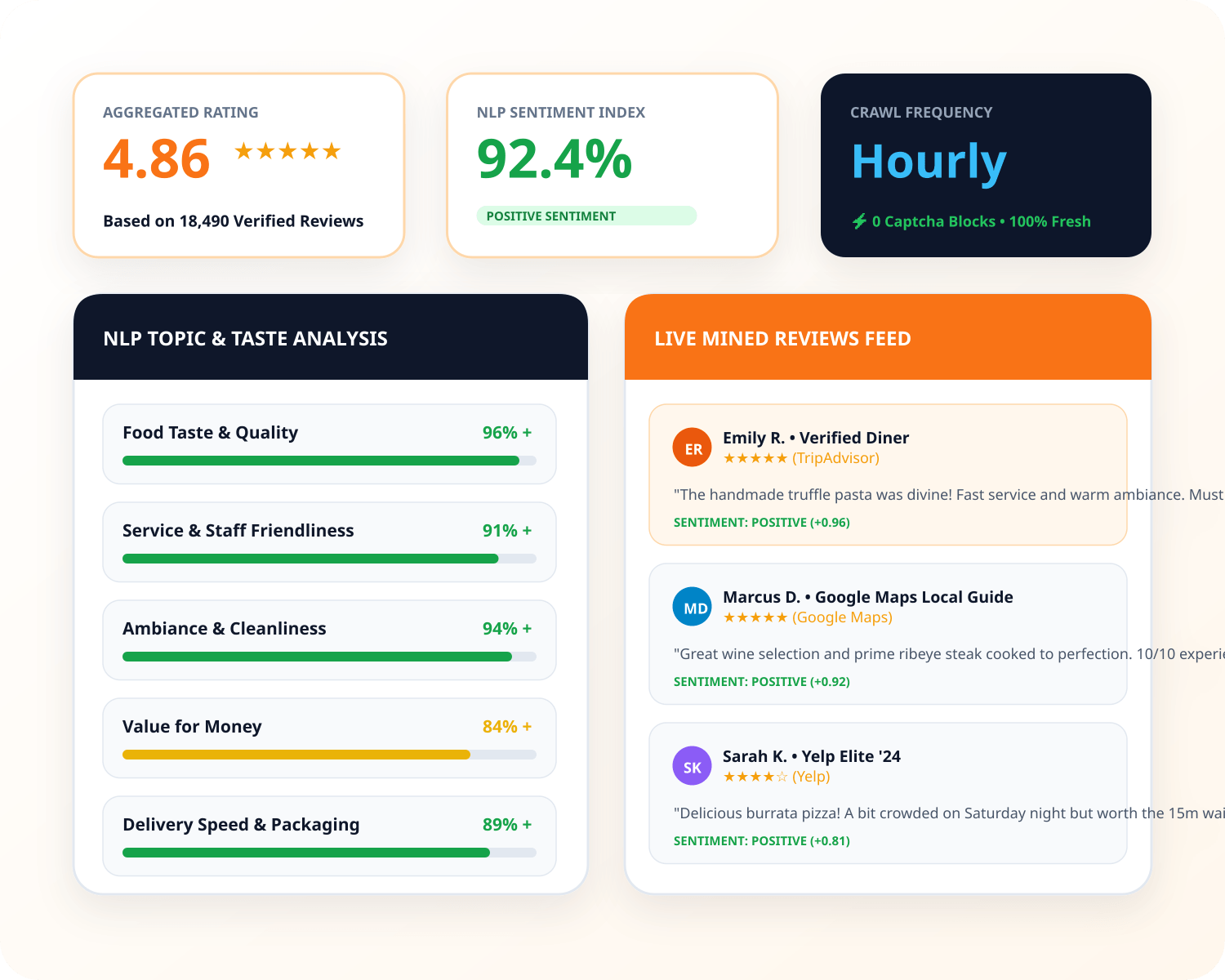
Aggregate consumer feedback at scale by scraping star ratings, review texts, verified diner statuses, and response counts from TripAdvisor, Yelp, Google Maps, and Zomato — enabling sentiment analysis, reputation monitoring, and competitive benchmarking.
- ✓Cross-Platform Review Aggregation: Collect review texts and ratings from Yelp, TripAdvisor, Google Maps, and Zomato in a unified review schema.
- ✓Sentiment & Topic Analysis: Feed scraped review texts into NLP pipelines to classify sentiment and surface recurring themes like service, food quality, or ambiance.
- ✓Competitor Rating Benchmarking: Track competitor rating trends over time to identify service quality gaps and benchmark your own restaurant performance.
Geolocation & Market Coverage Mapping
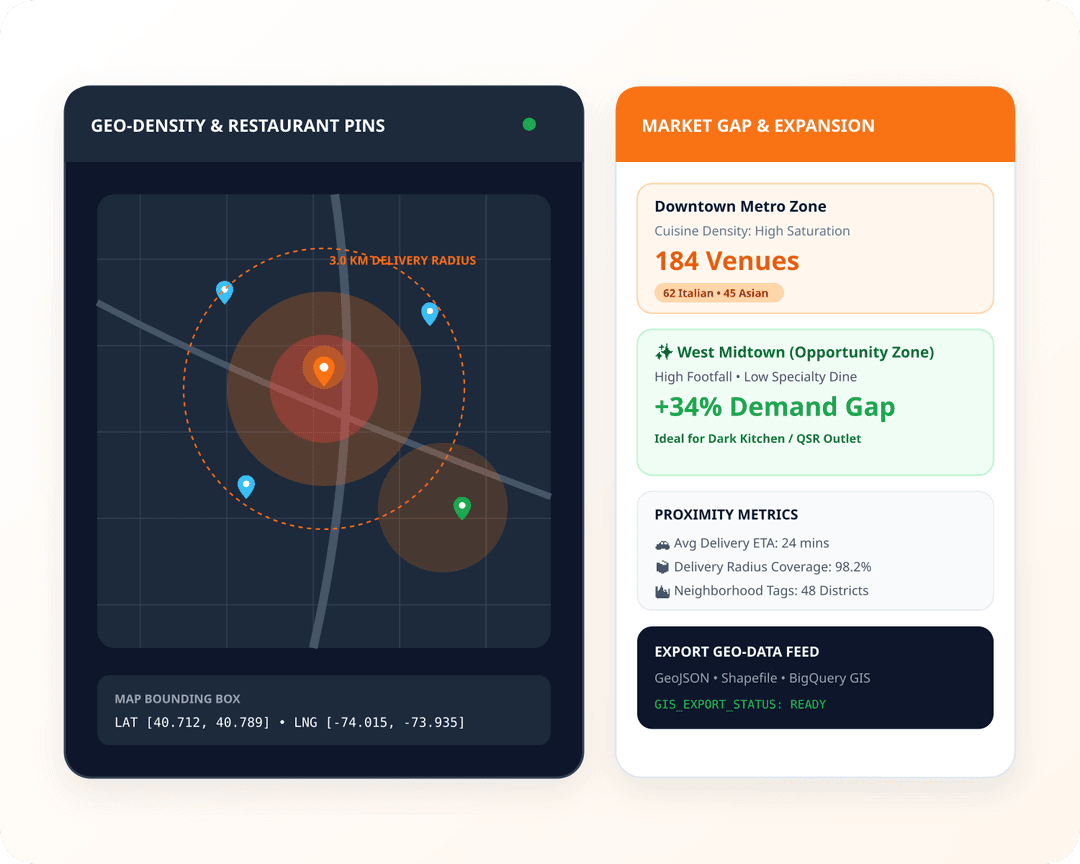
Extract geo-coded restaurant data with latitude/longitude coordinates, neighborhood classifications, and city-level density metrics to power location intelligence, market gap analysis, and site selection models for new restaurant openings.
- ✓Geo-Coordinate Extraction: Scrape precise latitude and longitude values for every restaurant record to power map visualization and proximity analytics.
- ✓Neighborhood & Zone Tagging: Classify restaurants by neighborhood, district, and delivery zone to enable hyper-local market analysis.
- ✓Restaurant Density Analytics: Measure cuisine category density and competitive saturation by area to identify expansion opportunities.
Why Food Businesses Trust Our Data Scraping Services
Power restaurant recommendation engines, food discovery apps, and local search tools with comprehensive, up-to-date restaurant profiles, menus, and ratings scraped from dozens of platforms.
Robust Food Data Ingestion Pipeline
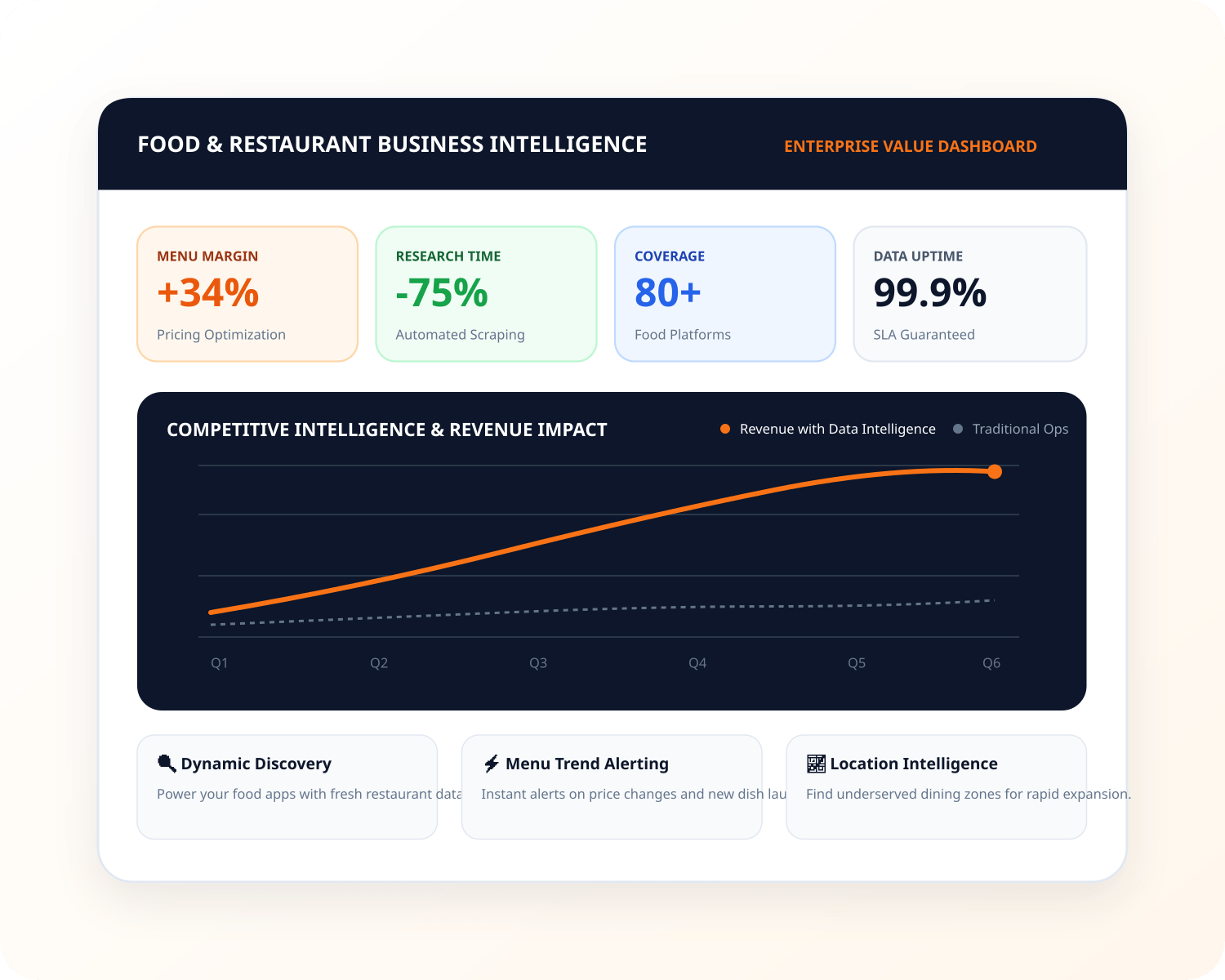
Our enterprise scraping stack handles JavaScript-heavy food portals, map-embedded listings, CAPTCHA-protected review pages, and dynamic menu rendering at global scale.
Menu Hierarchy Crawling
Systematically crawl nested menu structures across restaurant websites, food delivery apps, and listing portals to extract every category, item, and price combination.
Multi-Region Geo-Targeting
Query food directories from city-specific residential IPs to capture accurate localized menus, regional pricing, and market-specific restaurant listings.
Map API Data Extraction
Extract restaurant data embedded within Google Maps, Apple Maps, and Bing Places using browser-based rendering to capture all map-layer attributes.
Real-Time Menu Change Alerts
Trigger instant webhook notifications when competitor restaurants update their menus, change prices, or add new items.
Scheduled Monitoring Runs
Configure recurring scraping campaigns on hourly, daily, or weekly schedules to keep restaurant data fresh across all your monitored platforms.
Structured Data Delivery
Receive clean, normalized JSON or CSV feeds delivered directly into BigQuery, Snowflake, AWS S3, or your own food-tech API endpoint.
Popular Food & Restaurant Data Use Cases
How food-tech companies, restaurant chains, hospitality analytics firms, and market research organizations leverage scraped food data at enterprise scale.
Restaurant Discovery Platforms
Food-tech startups and aggregators scrape restaurant profiles, menus, and ratings to build comprehensive local dining discovery and search products.
Menu Intelligence & Pricing Strategy
Restaurant chains and QSR brands monitor competitor menus and pricing across cities to fine-tune their own item pricing and promotional calendars.
Food Trend & Category Analysis
Market research firms analyze scraped menu data at scale to identify emerging cuisine trends, dietary preference shifts, and new food category growth.
Site Selection & Expansion Planning
Restaurant groups and cloud kitchen operators use geo-coded competitor density data to pinpoint optimal locations for new outlet or dark kitchen openings.
Extract Food Data from Leading Restaurant Platforms
We scrape restaurant profiles, menus, ratings, and reviews from major global and regional food directories, maps, delivery apps, and hospitality portals.


